In the middle of Nazi Germany, while Allied planes were turning cities into smoking debris, a lone engineer named Konrad Zuse sat sketching out the future of programming on loose sheets of paper. Not weaponry. Not war machines. But logic, loops, and lists. That’s not the start of a sci-fi film—it’s how Plankalkül was born. A programming language that looked like the distant ancestor of Python and Pascal… written before the term “programming language” even existed.
Zuse didn’t just build the first programmable computer (the Z3)—he also invented the software to run it.
Let’s be clear: Plankalkül wasn’t just a list of machine instructions. It was a vision. Zuse imagined structured programming, variables, types, procedures, and even logical assertions—while the rest of the world was still debugging vacuum tubes with multimeters. This was around 1945. That’s twelve years before FORTRAN, and thirteen before Lisp. Yet somehow, Zuse isn’t a household name in tech. Why? Mostly because he had terrible luck and terrible timing.
Germany was imploding, and so was any infrastructure that could've helped Zuse build momentum. The Z3? Destroyed in an air raid. Funding? Nonexistent. Community support? He was the community. The language? Written in meticulous German notation no one else could easily parse. It’s like he wrote the Rosetta Stone of programming, then accidentally buried it in the wrong century.
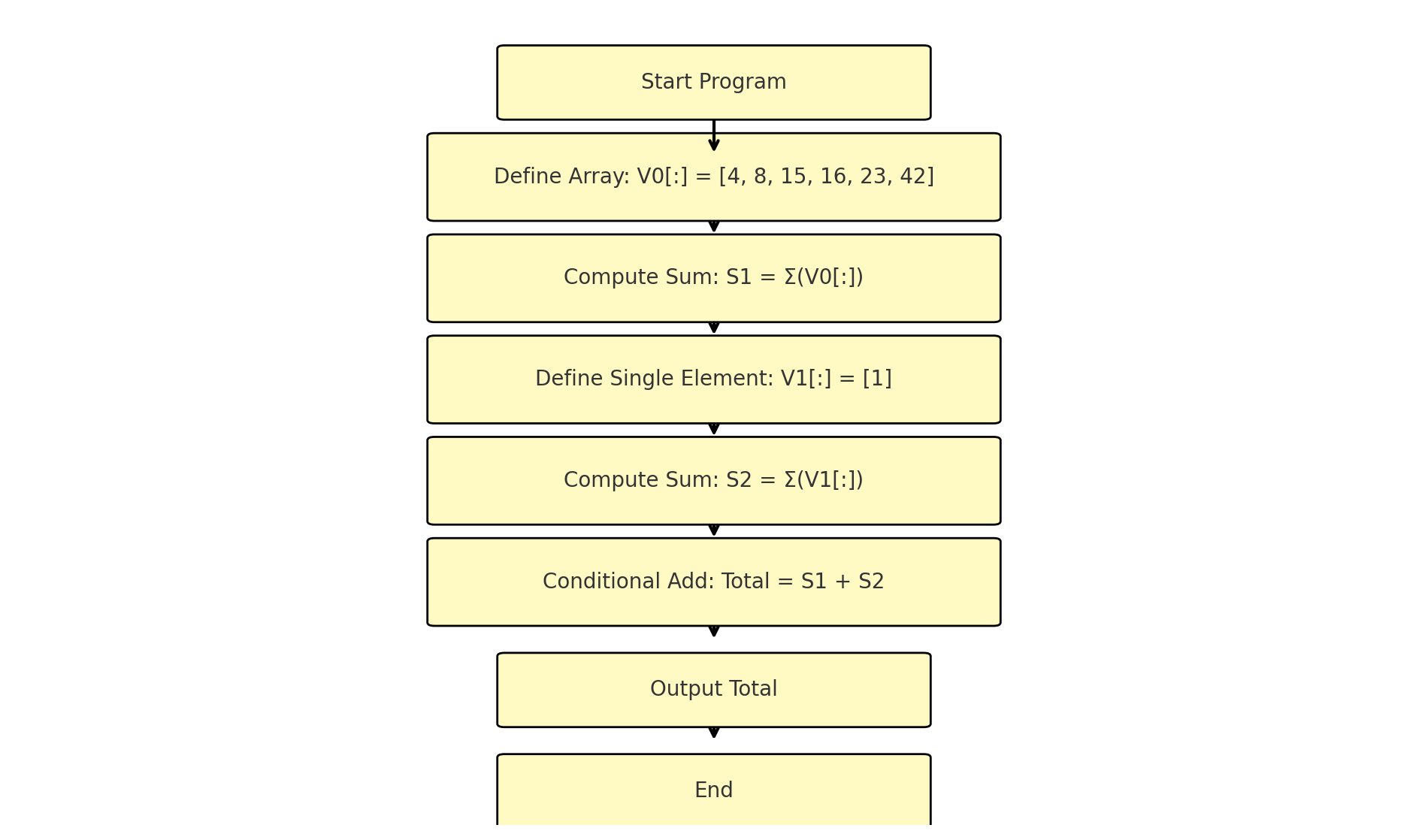
The logic of Plankalkül in action: arrays, summations, conditionals—before anyone had coined the term "structured programming".
Here’s where it gets technical—but stick with me, because this is the part that’ll blow your 21st-century developer mind.
Plankalkül supported:
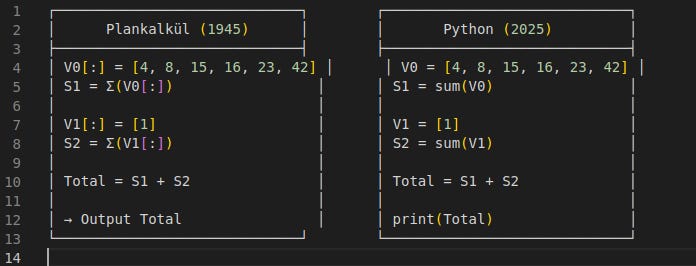
Multidimensional arrays (like V0[:] = [4, 8, 15, 16, 23, 42] from your diagram)
Quantified summations (Σ, just casually bringing in a bit of mathy swagger)
Conditionals and branching logic
User-defined functions and procedures
Type declarations ...all in a clean, mathematically rigorous syntax. If you squint, it almost looks like early pseudocode for scientific Python or NumPy. Except it was conceived while food was rationed and electricity was patchy.
Caption: 75 years later, and it still looks oddly familiar, doesn't it?
Here’s my favorite part: Zuse never even got to run a Plankalkül program. The machines weren’t powerful enough. The idea existed only in theory—on paper—for decades. The first interpreter wasn’t built until the 1970s. And even then, it was more of an academic curiosity than a tool. It's like designing a spaceship before we invented the wheel.
And yet… despite its obscurity, Plankalkül left fingerprints on the future. Scholars point out its resemblance to ALGOL, which influenced C, which influenced pretty much everything. It's the great-grandparent you never met, but still inherited your eyebrows from.
Zuse wasn’t just coding before coding was cool. He was coding before coding was even possible.
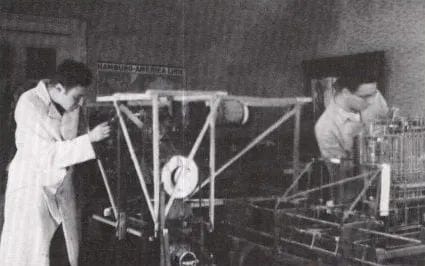
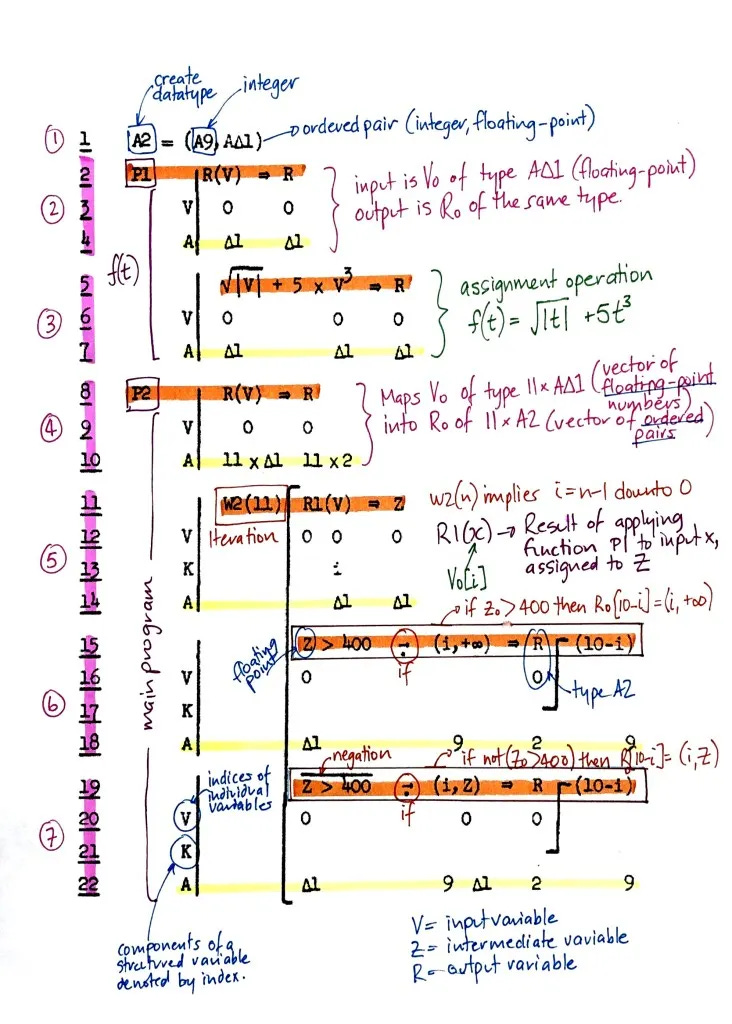
Caption: If you think debugging modern code is hard, try deciphering logic written in post-war German notation with no IDE.
If Plankalkül Were Used Today
What would modern computing look like if Plankalkül — the world's first high-level programming language — had become the foundation of software development? Here's a speculative glance at how today’s systems might express themselves in Zuse’s formal, structured style.
☁️ Cloud Deployment Logic
region := "eu-central-1"

if sum(costs[:]) <= monthly_budget:
    launch_instance(type: "t2.micro")
A controlled, condition-driven deployment—Zuse would’ve appreciated the deterministic clarity.
🧠 AI Prompt Logic
goal := generate(response[:]) and tone == "friendly" and hallucination == false

output := GPT4(goal)
Rather than hoping a prompt works, we formally define what a “correct” output looks like. Zuse would approve of the precision.
🧪 Software Test Case
exists(user) such that:
    input ≠ null and output == expected_result

then:
    test_passed()
Plankalkül emphasized formal verification before it was mainstream—Zuse essentially proposed preconditions and assertions decades ahead of their time.
So here’s the kicker: Why don’t we hear more about Plankalkül? Because history isn’t always fair. Zuse didn’t have the backing of the U.S. military-industrial complex. He wasn’t working at Bell Labs or IBM. He was in his parents' apartment, inventing software between bomb alerts.
In another timeline, we’d all be learning "Plankalkül" 101 in college instead of C++. There’d be GitHub jokes about "Zuse-style syntax" instead of semicolon rage. But instead, we got the strange irony of the first modern programming language being both the future and a footnote.
So next time you run a loop, define an array, or pass a function—tip your hat to the man who wrote it all down when the rest of the world was too busy blowing itself up to notice.
Thanks for blazing! Subscribe to receive new posts and support our work at crossgl.net !